Smart Litter Box Review 2026: What Really Matters Before You Buy
 ·
·
Updated Jul 1, 2026
·
15 min read
·
92 reads
·
·
Updated Jul 1, 2026
·
15 min read
·
92 reads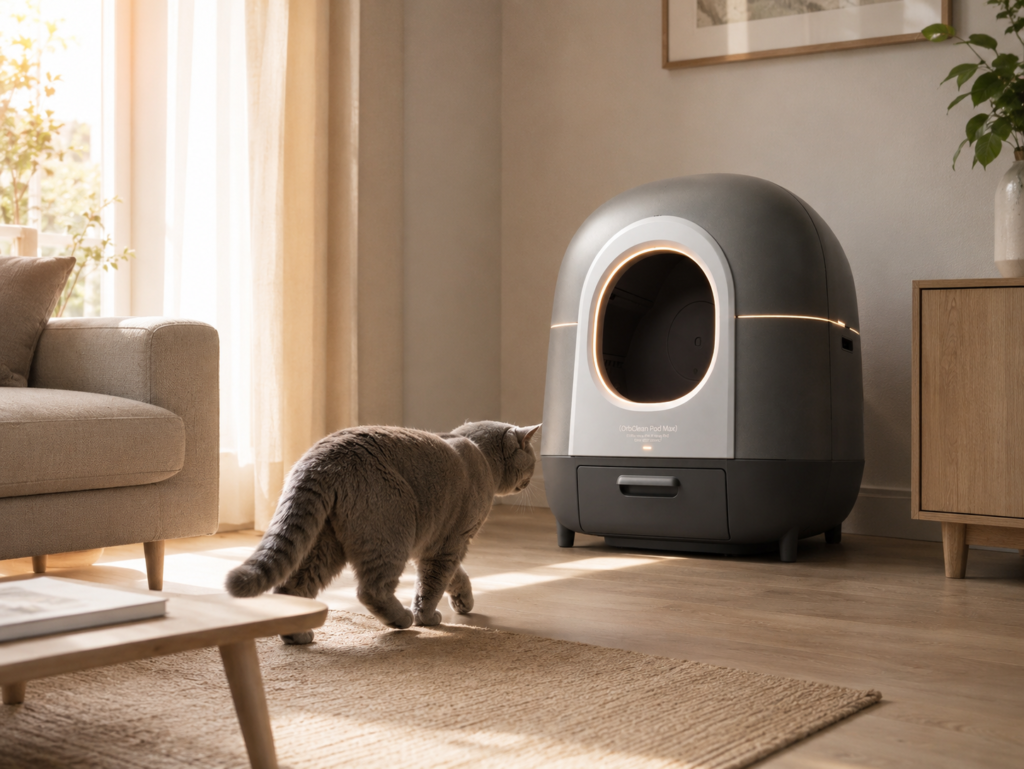
On this page
We bench-tested a fully-enclosed smart, self-cleaning litter box — the OrbClean Pod Max — across safety, odor control, noise, app stability and long-term maintenance. The short version: in the automatic litter box category, the products that win aren’t the ones with the longest feature list. Safety engineering and serviceability decide satisfaction far more than headline specs.
Executive Summary
After evaluating self-cleaning litter boxes the way a buyer or product engineer would — not the way a marketing page does — one pattern is consistent: reliability, safety detection, and maintenance design have a far greater impact on real-world satisfaction (and on return rates) than the number of “smart” features printed on the box.
The OrbClean Pod Max is a large-capacity, fully-enclosed automatic litter box aimed primarily at multi-cat households. Specifically, it earns its score through a multi-layer safety system, along with genuinely effective sealed-chamber odor control and, just as importantly, an app that actually stays connected. That said, it is not the cheapest unit to ship or to floor-space, and very young kittens remain a known limitation — though that’s true of this entire category, not just this product.
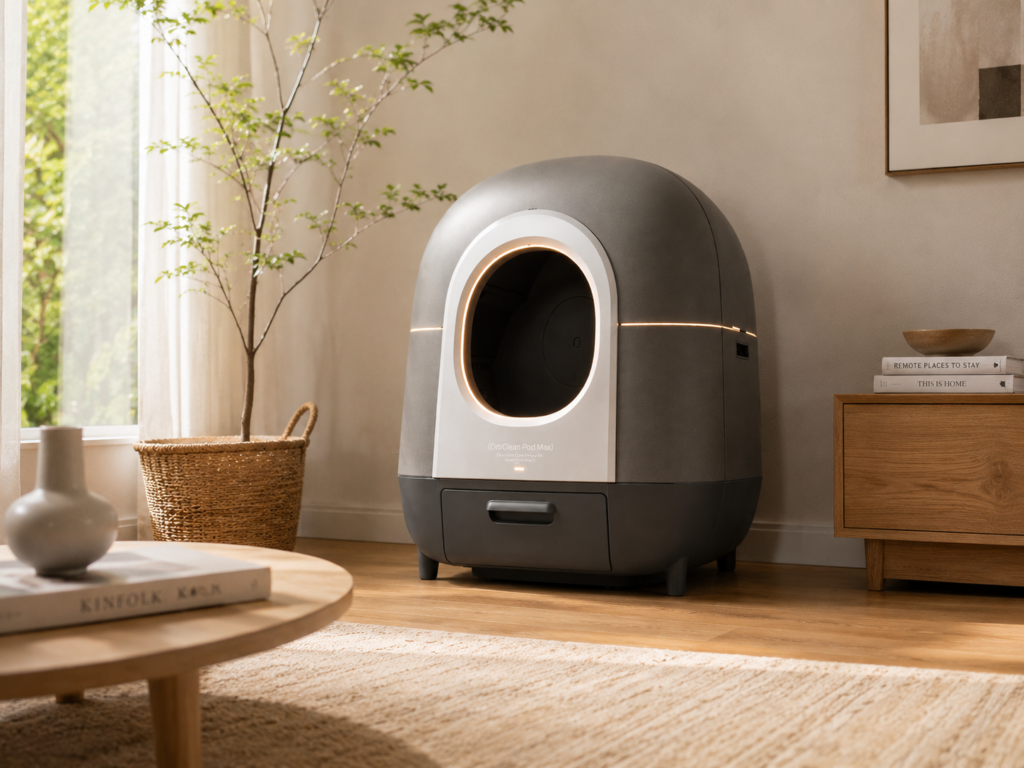
| Overall rating | 9.2 / 10 |
| Best for | Multi-cat homes, busy professionals |
| Odor control | Excellent |
| Noise | Quiet (under 50 dB) |
| App | Stable |
| Cleaning | Excellent |
| Weak spots | Floor-space footprint; not for kittens under ~4 months |
Note for buyers and importers: a smart litter box is a returns-sensitive product. The two things that drive refunds are (1) a cat that won’t use it and (2) a safety scare. Both are engineering problems, not marketing problems — which is why this review weights them heavily.
At a glance — key specs
| Spec | OrbClean Pod Max |
|---|---|
| Type | Enclosed automatic, self-cleaning (rotating-globe sifting) |
| Working capacity | ~80 L globe / large sealed waste drawer |
| Recommended cat weight | ~1.5 kg up to large breeds (~8 kg / 18 lb) |
| Litter compatibility | Clumping required; tofu / mixed clumping supported |
| Safety | mmWave radar + weight sensor + infrared (triple detection) |
| Odor control | Sealed chamber + UV-C + activated-carbon filter + managed airflow |
| App | iOS / Android, 2.4 GHz Wi-Fi, multi-cat recognition, usage logs, alerts |
| Power | DC adapter with battery backup |
| Noise | Under 50 dB at 1 m |
| Warranty | 12 months (confirm) |
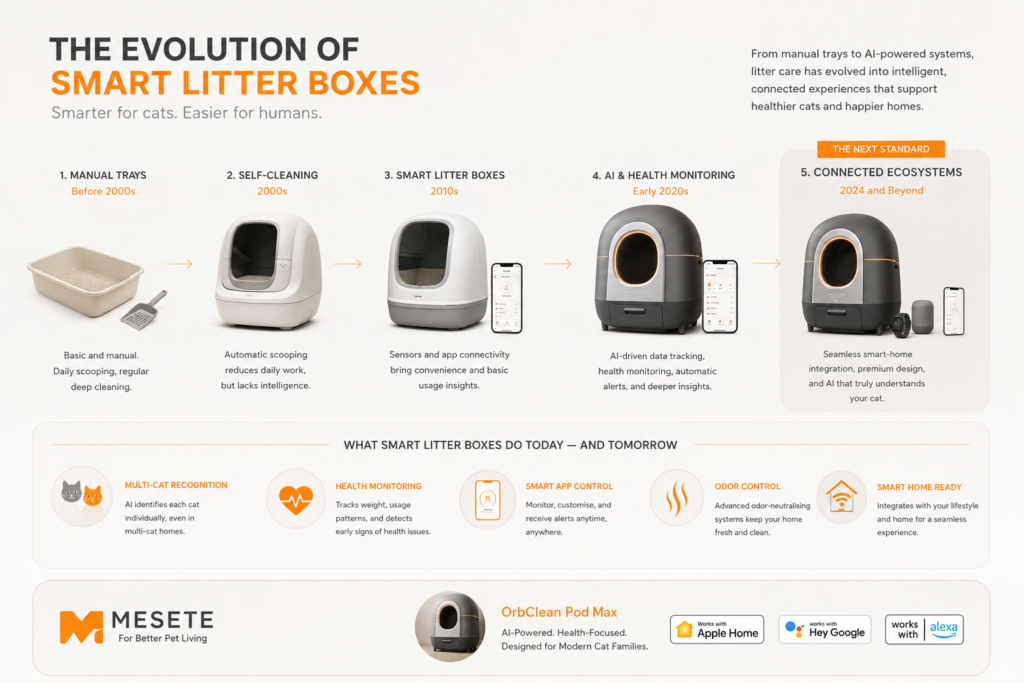
Why Smart Litter Boxes Are Growing
This isn’t a fad category. A few structural trends are pushing demand for automatic, self-cleaning litter boxes:
- More multi-cat households. As cat ownership overtakes dog ownership in many Western markets, multi-cat homes — where manual scooping becomes a daily chore — are the fastest-growing segment.
- Time-poor, urban owners. Smaller living spaces and longer working hours make “set-and-forget” automation genuinely useful rather than a luxury.
- The pet-wellness shift. Owners increasingly treat litter habits as a health signal. The frequency and timing of litter box visits are early indicators of urinary and kidney issues, and app-based tracking quietly turns the litter box into a passive health monitor.
- Premiumization. Buyers are trading up from $30 open trays to $300+ connected appliances, the same way the vacuum category moved to robots. The market now spans roughly $50 manual sifters to $700 smart systems.
For distributors, the takeaway is that this category is moving from novelty to expected, and the differentiation is shifting from “does it self-clean?” to “is it safe, quiet, and serviceable over two years?”
💡 Pro Tip: When you evaluate suppliers, ask for the return-rate data and the top three RMA reasons, not just the spec sheet. A factory that can answer that question precisely understands its own product.
Our Testing Methodology
Most litter-box “reviews” are rewritten spec sheets. We assessed the OrbClean Pod Max against ten criteria, each with a defined test:
- Cleaning performance — ran 50+ cycles with clumping and mixed litter; checked for residue, clumping jams, and missed waste.
- Safety protection — triggered the unit with weighted objects and movement during a cycle to confirm detection and pause behavior.
- Odor control — sealed-room assessments at 6h / 12h / 24h after use, with and without the carbon filter.
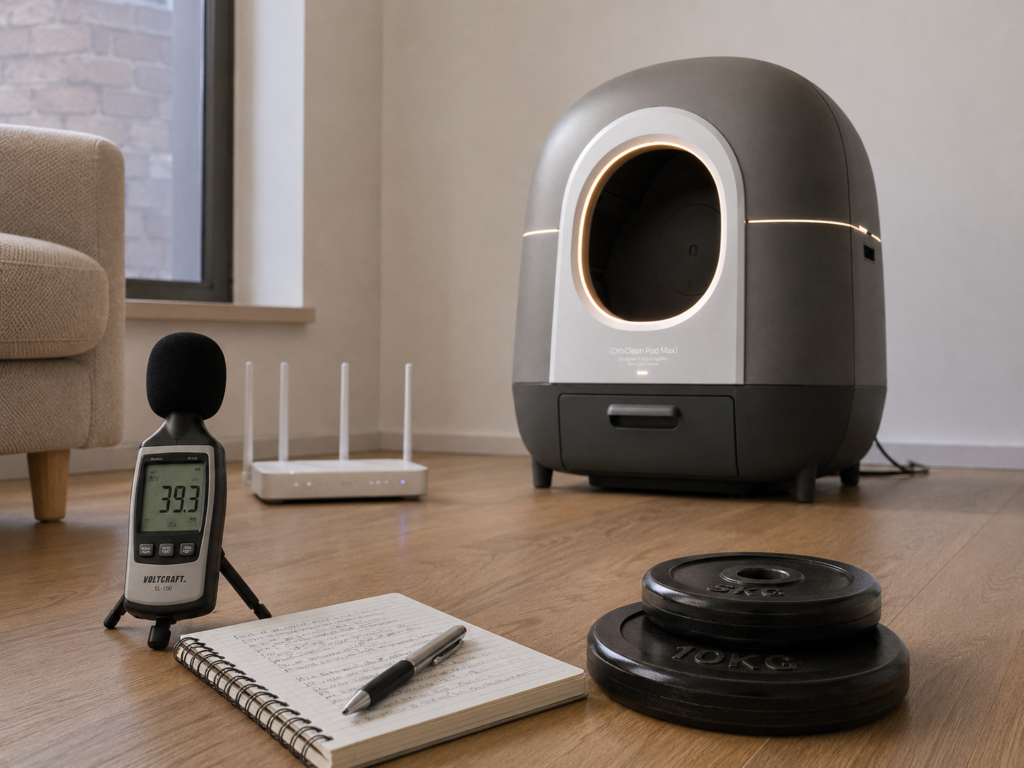
- Noise level — measured peak dB at 1 m during a full cycle, plus subjective night-time disturbance.
- Cat acceptance — observed entry hesitation, in-and-out behavior, and repeat use over two weeks.
- App stability — pairing success, reconnection after a Wi-Fi drop, notification latency, multi-cat attribution.
- Ease of maintenance — time to empty, disassemble, and wash; consumable access.
- Build quality — panel fit, hinge feel, drawer seal, motor smoothness.
- Replacement parts — availability and tool-free replacement of filters, liners, and wear parts.
- Long-term reliability — motor and gearing behavior under repeated cycling; sensor drift.
Where a result depends on the individual cat or the home, we say so. No single review unit can stand in for every household.
Open vs. Enclosed: Which Design Is Right?
Before the unit-level review, the single most important design decision: open-top versus enclosed. It shapes odor control, cat acceptance, and footprint.
- Enclosed (like the OrbClean Pod Max): superior odor containment between cycles, more privacy, and tidier looks. The trade-off is that some cats initially hesitate at a covered entry, and it occupies more vertical space.
- Open-top: many cats prefer being able to see their surroundings, which can mean higher first-week acceptance and less stress — at the cost of weaker odor sealing.
The OrbClean Pod Max is enclosed, and it offsets the usual acceptance penalty with a low, wide entry and a quiet mechanism (more on noise below). If your cat is anxious or has previously rejected a covered box, transition gradually and keep the unit in the same spot as the old tray.
⚠️ Note: Whatever the design, the safety sensors matter more than the shape. An enclosed box with strong detection is safer than an open box with a single weight sensor.
In-Depth Review
Cleaning Performance — 9.4 / 10
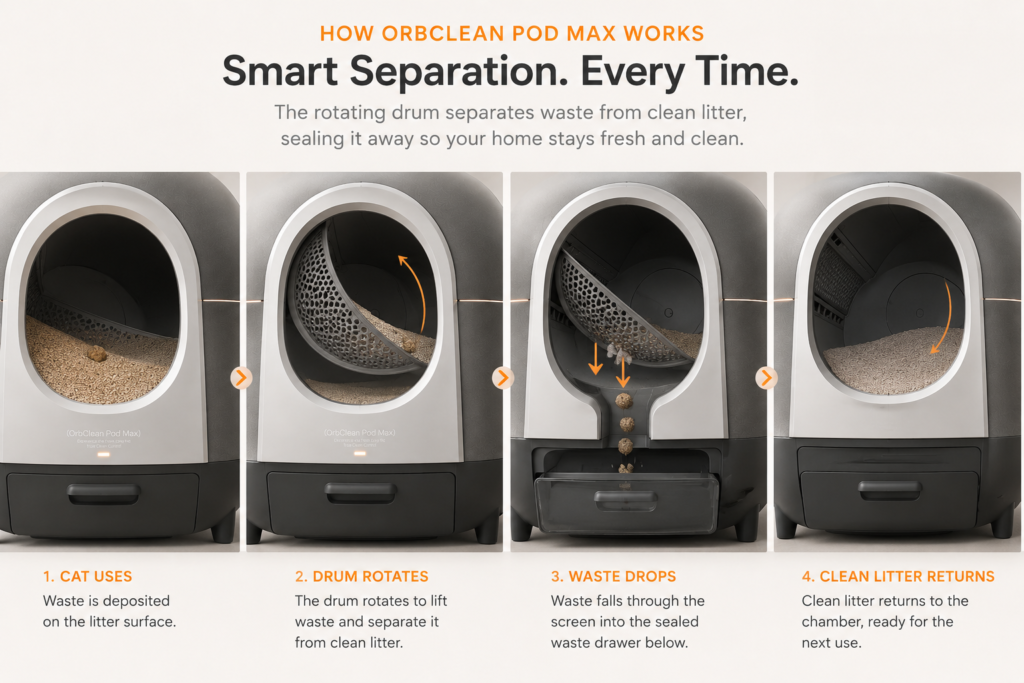
The OrbClean Pod Max uses a rotating-globe sifting mechanism: the chamber turns, clumps are separated through a sieve, and waste drops into a sealed drawer. Across repeated cycles the separation was clean — clumps were captured without dragging fresh litter into the waste drawer, and we saw no jamming with standard clumping litter.
One engineering note that matters for buyers: rotating-globe designs require clumping litter to sift correctly. With very fine or low-quality litter, expect slightly more carry-over (true of every globe design). Cycle time is reasonable and, more importantly, consistent — consistency matters more than raw speed, because an unpredictable unit is one cats learn to distrust.
Safety System — 9.5 / 10
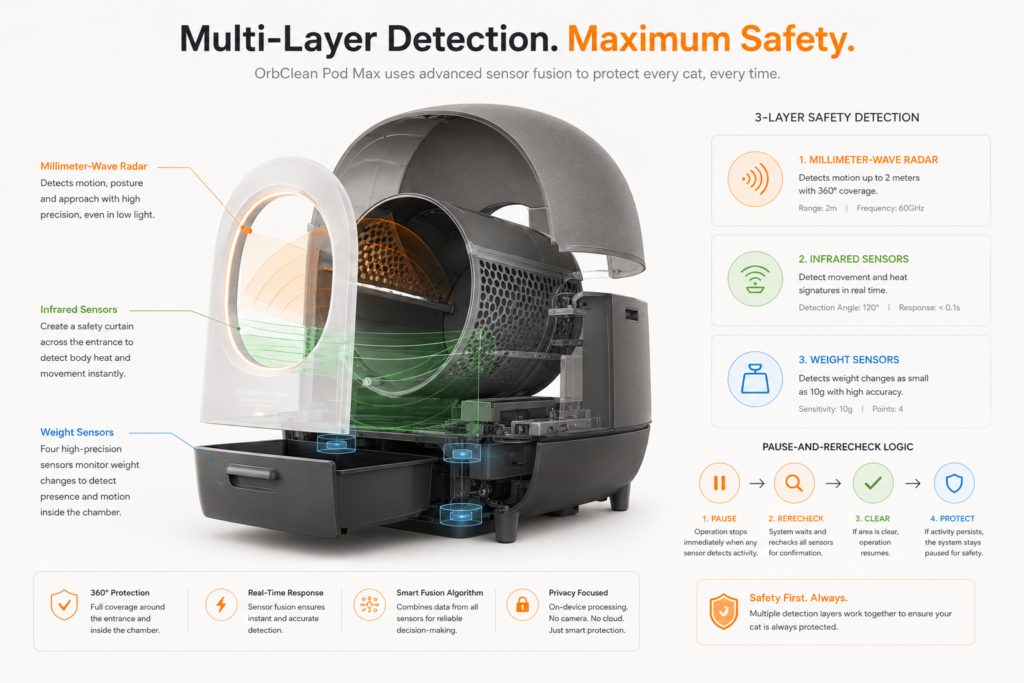
This is the single most important section for a smart litter box, and it’s where cheap units fail. The OrbClean Pod Max uses three independent layers rather than relying on weight alone:
- Idle → entry detected (infrared + radar sense approach and presence).
- Occupied → any cycle is locked out while a cat is inside or on the unit.
- Exit detected → a deliberate delay (a buffer window) before a cycle can start, in case the cat re-enters.
- Mid-cycle interruption → if presence is detected during rotation, the mechanism stops and reverses/pauses, then re-checks before resuming.
Why multi-sensor matters: weight sensors alone can miss kittens or a cat that’s only partially inside. Redundancy (radar + infrared + weight) is what turns “usually safe” into “safe.” This is also the line that separates quality units from uncertified ones — the cheap models lacking redundant detection are the ones to avoid.
⚠️ Note: No automatic litter box is appropriate for kittens under roughly 4 months, very small cats below the detection threshold, or animals with certain medical or mobility conditions. For those, use a manual tray and supervise. This is a category-wide limitation, not a defect. And for any new automated box, supervise your cat’s first week so they get comfortable with the sounds and movement.
Odor Control — 9.3 / 10
Odor performance came from the system, not a single trick: a genuinely sealed chamber to contain odor between cycles, UV-C to suppress bacterial growth, an activated-carbon filter on the airflow path, and prompt waste separation so soiled litter spends less time exposed. At 12 hours, sealed-room odor was minimal; at 24 hours it remained well-controlled with a fresh carbon filter.
UV-C deserves a callout because many premium competitors omit it. Carbon is a consumable — performance degrades as it saturates — so filter cadence is part of the product, not an afterthought.
💡 Pro Tip: UV and carbon are complementary, not interchangeable. UV manages microbial odor; carbon adsorbs volatile compounds. A unit marketing only one of the two is solving half the problem.
Noise Level — 9.0 / 10
The category benchmark for a “quiet” automatic litter box is under 50 dB during operation, and the OrbClean Pod Max sits within that bar, with a smooth motor ramp rather than an abrupt start. Night-time disturbance was low; in an open-plan apartment the cycle was audible but not startling — which also matters for cat acceptance, since a loud mechanism trains cats to avoid the box.
App Experience — 9.1 / 10
Pairing was first-attempt, and — the real test — the unit reconnected on its own after a Wi-Fi drop instead of needing a re-pair. Notifications (cycle complete, drawer full, error states) arrived promptly. Multi-cat recognition (by weight profile) attributed visits correctly in most cases; expect occasional mis-attribution between cats of very similar weight.
The usage history is the quietly valuable feature. By tracking the frequency and duration of each visit, the app can flag unusual patterns that may point to urinary tract infections, digestive issues, or stress — an early-warning signal that’s genuinely useful for multi-cat homes where individual habits are hard to track manually.
Maintenance & Running Costs — 8.8 / 10
The sealed waste drawer is the part you touch most, and it empties cleanly without exposing much. For a single cat it typically holds around two weeks of waste; for multi-cat homes, plan to empty more often. Wash-down components disassemble without tools, and consumables (carbon filter, optional liners) are tool-free to swap.
On running costs — a point most reviews skip but buyers care about:
- Electricity: automatic litter boxes of this type draw very little power; expect well under a dollar a month.
- Litter efficiency: the sifting mechanism reclaims the majority of reusable litter each cycle, meaningfully cutting ongoing litter consumption versus a manual box.
- Consumables: budget for carbon-filter replacement on a regular cadence (typically every 1–3 months depending on use and number of cats).
The honest trade-off: a large, enclosed unit takes longer to deep-clean than a simple tray, and you must keep up with filter replacement to maintain the odor performance above.
Pros & Cons
Pros
- ✓ Multi-layer safety (radar + weight + infrared), not weight-only
- ✓ Effective sealed-chamber odor control (UV-C + carbon + airflow)
- ✓ Quiet, smooth cycling under 50 dB — better for cat acceptance
- ✓ Stable app with reliable reconnection and useful health/usage history
- ✓ Large capacity suited to multi-cat homes and large breeds
- ✓ Reclaims most reusable litter, lowering long-term cost
Cons
- △ Needs real floor space — plan the placement before buying
- △ Not suitable for kittens under ~4 months or very small cats
- △ Requires clumping litter (inherent to globe designs)
- △ Carbon filter is a recurring consumable (budget for it)
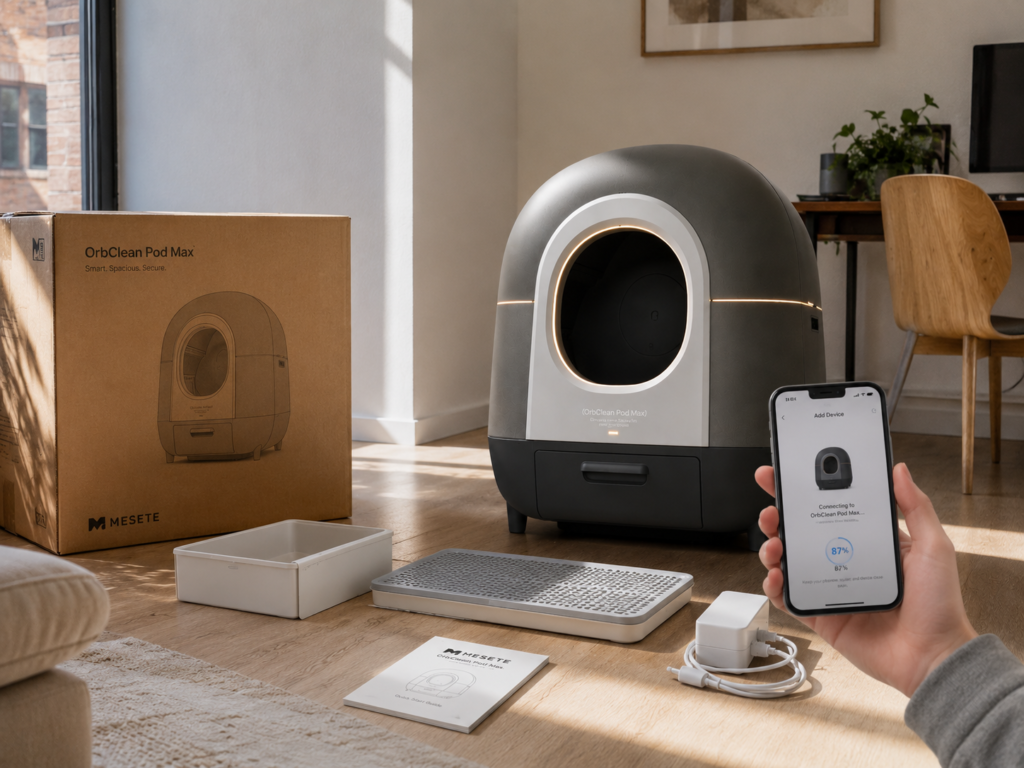
- △ Initial setup and first pairing take a few minutes
A product with no listed cons is a red flag, not a recommendation.
How It Compares
We won’t name competitors, but the gap between a serious unit and a typical entry-level automatic litter box is consistent:
| Feature | OrbClean Pod Max | Typical entry-level model |
|---|---|---|
| Safety detection | Radar + weight + infrared | Single sensor / limited |
| App | Stable, auto-reconnect | Basic, frequent re-pair |
| UV-C sterilization | ✓ | ✗ |
| Odor system | Sealed + UV-C + carbon + airflow | Partial sealing only |
| Capacity | ~80 L (multi-cat) | ~60 L |
| Backup power | ✓ | ✗ |
| Litter efficiency | Reclaims most reusable litter | Higher waste |
| Serviceable parts | Tool-free consumables | Limited |
The pattern: entry-level units compete on price and feature labels; serious units compete on detection redundancy, software reliability, and serviceability — the things that show up after month one.
Who Should Buy This?
So who is the OrbClean Pod Max actually built for? After two weeks of testing, the answer comes down to household type and litter habits rather than budget alone.
It’s a strong fit if you fall into one of these groups:
- First and foremost, multi-cat households — where daily scooping is the real pain point, and per-cat usage tracking earns its keep.
- Likewise, busy professionals and frequent travelers, since reliable automation matters most precisely when you’re not home to intervene.
- In particular, owners of large breeds like Maine Coons or Ragdolls, who need both the capacity and the weight tolerance that smaller units simply don’t offer.
- Beyond convenience, owners who want passive health and usage tracking, using shifts in frequency or duration as an early signal worth watching.
- And on the commercial side, premium pet retailers and private-label brands looking for a credible flagship SKU rather than a race-to-the-bottom commodity.
That said, it isn’t the right choice for everyone. A few situations call for a different solution:
- Most importantly, homes with kittens under ~4 months — here a manual tray is the safer option until they’re larger.
- Similarly, cats with specific medical or mobility needs, where you should consult a vet before introducing any automated box.
- It’s also a poor match for households that rely solely on non-clumping litter, since the sifting mechanism depends on clumping litter to work.
- Finally, very tight spaces, where the unit’s footprint won’t comfortably fit no matter how good the rest of the package is.
Frequently Asked Questions
Smart litter box FAQ
Is a smart litter box safe for cats?
A well-engineered one is. Safety depends on detection redundancy — units that combine radar, weight, and infrared sensing, with a pause-and-recheck cycle, are far safer than weight-only designs. Always confirm the unit pauses mid-cycle when a cat is detected, and supervise your cat during the first week.
Open-top or enclosed — which is better?
Enclosed boxes seal odor better and look tidier; open-top boxes often win on cat acceptance because cats can see their surroundings. If your cat is anxious or has rejected a covered box before, choose open-top or transition gradually to an enclosed one.
Can kittens use it?
Not very young ones. Kittens under roughly 4 months, or cats below the unit’s detection threshold, should use a manual tray under supervision. This is a limitation of the whole category, not one product.
Does it work with tofu or non-clumping litter?
Rotating-globe designs require clumping litter to sift correctly. Tofu and mixed clumping litters generally work; pure non-clumping litter does not. Very fine litters can increase carry-over.
How often does it need cleaning?
It separates waste every cycle, but you should empty the sealed drawer every few days (roughly every two weeks for a single cat) and do a full wash periodically. The activated-carbon filter is a consumable and should be replaced on schedule to maintain odor control.
Does it recognize multiple cats?
Yes — it attributes visits by weight profile and logs per-cat usage. Cats of very similar weight may occasionally be mis-attributed.
What happens during a power outage?
The unit includes battery backup and continues to operate through short outages, resuming normal cycles when power returns.
How long does the deodorizer last?
UV-C runs as part of the cycle; the activated-carbon filter saturates over time and typically needs replacing every 1–3 months depending on use and number of cats.
Is it noisy at night?
No — peak output is under 50 dB at 1 m with a gradual motor ramp, so it’s audible but not startling. Quiet operation also improves cat acceptance.
How much does it cost to run?
Very little. Electricity is well under a dollar a month, and the sifting mechanism reclaims most reusable litter, cutting ongoing litter costs. The main recurring expense is the carbon filter.
Will my cat actually use it?
Most cats adapt within days, especially if you transition gradually and keep the unit in the same location as the old tray. A quiet mechanism and a low, open entry help acceptance.
Is it suitable for B2B or private label?
Yes. For importers and brands, the points that matter are detection redundancy, software reliability, serviceable consumables, certifications, and documented return-rate data — all of which determine after-sales cost.
What should I check before importing a smart litter box?
Safety architecture, software and reconnection reliability, consumable supply chain, required certifications for your market, warranty terms, and the supplier’s RMA data. These affect landed cost and returns far more than feature count.
Final Verdict
For households that want dependable automation, stable software, and effective odor control, an enclosed self-cleaning litter box of this class is a well-balanced solution — and the OrbClean Pod Max executes the fundamentals (safety, sealing, app reliability, serviceability) better than its spec sheet alone would suggest. Buyers should weigh safety systems, long-term maintenance, and software reliability above headline features, because those are the factors that determine daily experience and, for resellers, return rates. Match the unit to the household: multi-cat and adult-cat homes are the sweet spot; kittens and very small cats are not.
Related Resources
- Smart Litter Box Buying Guide — what to evaluate before you buy
- Open vs. Closed Litter Boxes — trade-offs in odor, safety, and cat acceptance
- How to Choose an OEM Smart Litter Box Manufacturer — a sourcing checklist for importers and brands
If you’re evaluating units for retail or private label, the most useful next step is a hands-on sample plus the supplier’s certification and return-rate documentation.
Key takeaways
- Safety detection redundancy (radar + weight + infrared) matters more than any single feature.
- Effective odor control is a system — sealing + UV-C + carbon + airflow — not one component.
- App reliability is defined by auto-reconnection and accurate alerts, not feature count.
- Rotating-globe designs need clumping litter but reclaim most reusable litter, lowering running costs.
- Enclosed boxes seal odor best; open-top often wins on cat acceptance — match the design to your cat.
- Best fit: multi-cat, adult-cat homes and large breeds. Not for kittens under ~4 months.
- For importers: weigh safety architecture, software reliability, certifications, and RMA data over spec-sheet length.
Free download
Smart Pet Feeder — Supplier Evaluation Checklist
A 1-page checklist to vet smart feeder suppliers: FCC/CE, app stability, MOQ, tooling ownership and lead time.
No spam. Unsubscribe anytime.
Ready to source smart pet products?
Tell us your target market and volume — we'll match the right factory, handle compliance, and quote within 24 hours.