OEM vs ODM Pet Products: Which Manufacturing Model Fits Your Smart Pet Brand?
 ·
·
6 min read
·
49 reads
·
·
6 min read
·
49 reads
On this page
The manufacturing model you choose shapes how fast you launch, how unique your product is, and how much margin you keep. Many brand owners walk into factory conversations without a clear answer to one question: OEM or ODM? Picking wrong means either a generic product nobody remembers, or a development cycle that drains cash before you ship. This article lays out the real trade-offs — not the textbook definitions — based on 9 years of building smart pet hardware for global brands.
What’s the real difference between OEM and ODM?
OEM (Original Equipment Manufacturing) means you select from an existing product platform and the factory builds it under your brand. You control branding, packaging, and go-to-market — the factory handles production, QC, and supply chain.
ODM (Original Design Manufacturing) goes deeper: the factory co-develops the product with you — from industrial design and engineering through certification and mass production. You get a product that is yours, not a relabeled catalog item.
The table below captures the core trade-off:
| OEM | ODM | |
|---|---|---|
| Starting point | Existing platform | New development |
| Time to market | 2–6 weeks | 8–16 weeks |
| MOQ | 100–500 units | 500–1,000+ units |
| Unit cost at scale | Moderate | Lower (mold amortized) |
| Differentiation | Limited | Strong |
| Mold ownership | Factory retains | Customer owns |
| Certification | Existing certs apply | New certification needed |
| Best for | Market validation, speed-first launches | Brand building, premium positioning |
OEM model: fast, lean, lower risk
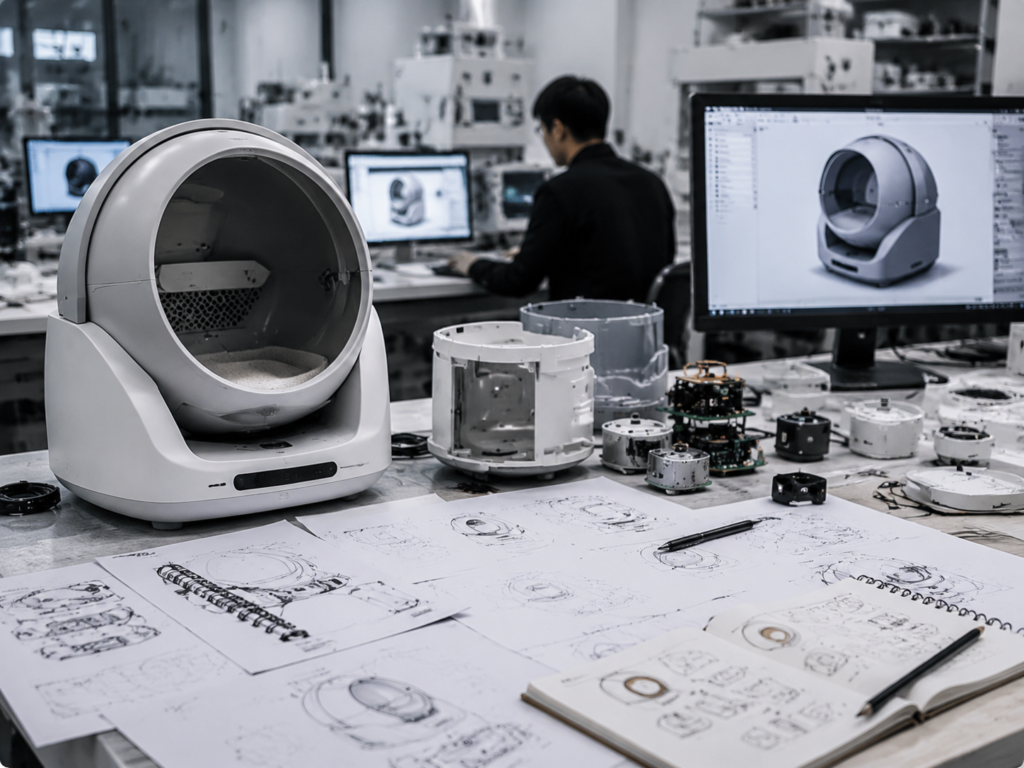
For brands testing a new category or market, OEM is the practical first step. The process is straightforward: select a proven product platform → customize branding, packaging, color, and accessories → confirm specs → testing and compliance review → production → shipment. A typical OEM smart litter box project can move from confirmation to container in 3 to 6 weeks.
Who OEM fits best
- New pet brands — validate demand before committing to mold investment. OEM lets you test with 100–300 units without the overhead of full private label pet product development.
- Retailers expanding categories — if you already own distribution channels, OEM adds smart pet SKUs without building an engineering team.
- Brands entering new regions — a European distributor testing smart feeders in Benelux might run OEM first, gather feedback, then commission ODM for a region-specific model.
Real example: A European pet brand wanted into the premium automatic litter box category but needed to launch within one quarter. Rather than developing every component from scratch, they selected an existing smart litter box platform — customizing branding, packaging, and market-specific documentation. The result: category entry in under five weeks, with ODM development planned for year two based on customer feedback.
ODM model: your design, your IP, higher barriers
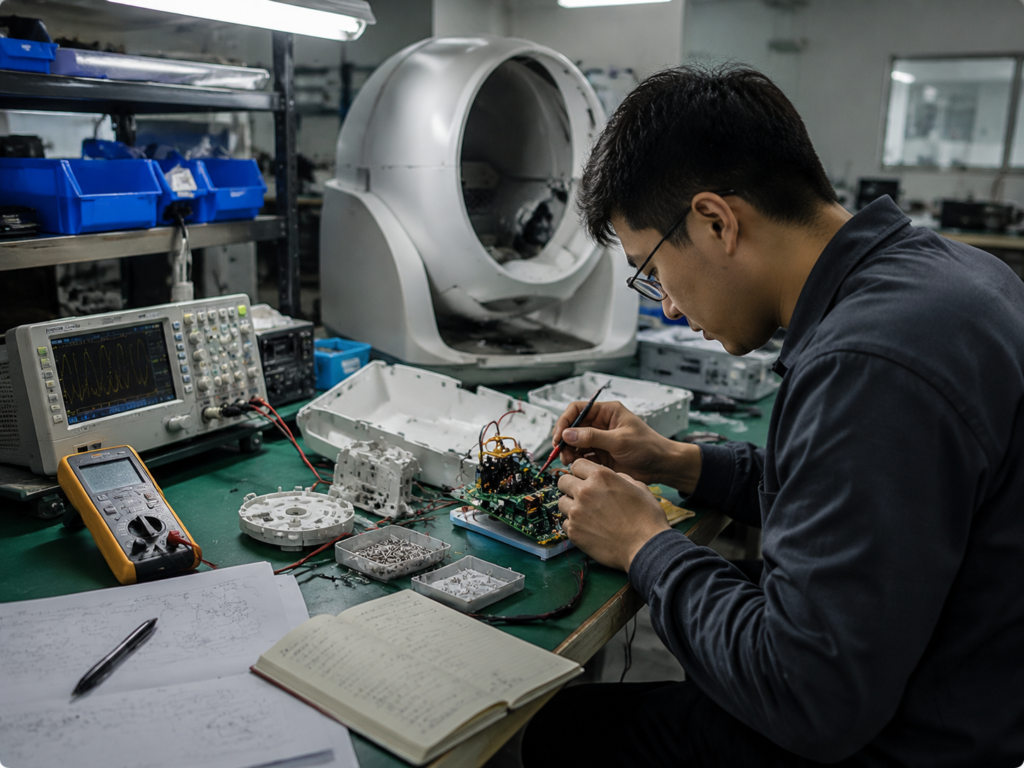
When differentiation is the strategy — not just another SKU — ODM is the right lever. A modern smart pet product is not a plastic housing. It’s sensors, motors, PCBs, firmware, a mobile app, safety interlocks, and cloud infrastructure. ODM puts all of that under your brand’s design language and feature spec.
A complete ODM cycle typically runs 8 to 16 weeks across eight stages:
- Market research — target customers, competitor products, price positioning
- Concept development — feature set, UX flow, technical requirements
- Industrial design — enclosure, structure, user interaction
- Engineering — mechanical, PCB, sensors, motors, firmware
- Smart system integration — app (iOS + Android), cloud backend, OTA pipeline
- Testing & certification — CE, FCC, RoHS, REACH as needed
- Pilot production — validate performance, assembly consistency, QC gates
- Mass production — scale to global distribution volumes
Who ODM fits best: established brands with design teams, companies targeting premium price tiers, and any brand where “me-too” is a business risk. Typical ODM MOQ starts at 500–1,000 units because mold and engineering NRE must amortize across the production run.
How to choose: 5 questions
This isn’t a theoretical exercise. Answer these five questions honestly and the direction becomes clear:
- Do you already have your own product design or industrial design file? Yes → ODM. No → OEM is the faster path.
- What’s your target retail price tier? Value/mid-market → OEM unit economics work. Premium → ODM margins justify the upfront investment.
- What’s your initial order volume? Under 500 units → OEM. Above 1,000 units → ODM becomes cost-competitive per unit.
- How fast do you need to launch? Under 2 months → OEM. 3–4 months or more → ODM is feasible.
- Do you need control over hardware and software? If you care about PCB layout, sensor selection, firmware behavior, or app UX — you need ODM. These layers can’t be meaningfully customized on an OEM platform.
OEM → ODM: the growth path most brands follow
Most successful pet brands don’t pick one model permanently. They evolve:
Stage 1 — Market validation (OEM): Launch with an existing platform. Test demand, understand real customer feedback, build sales channels. Investment is low; learning is high.
Stage 2 — Product optimization: Iterate on packaging, accessories, firmware tweaks, and user documentation based on Stage 1 data.
Stage 3 — Exclusive ODM development: Commission a unique product with differentiated features, mold ownership, and defensible margins — now backed by real market evidence, not assumptions.
This staged approach reduces financial risk while preserving the option to build a defensible product line later. A factory that can support both models under one roof saves you the cost of switching partners mid-growth.
Frequently Asked Questions
What’s cheaper — OEM or ODM?
OEM has lower upfront cost because you use an existing platform with no mold or engineering NRE. At scale (1,000+ units), ODM unit cost is often lower because mold amortization and optimized BOM reduce per-unit expense.
Can I switch from OEM to ODM later?
Yes — this is the most common path. Brands validate the market with an OEM product, collect real customer feedback, then commission ODM development for a differentiated follow-up. A partner that does both avoids the friction of switching factories mid-stream.
Who owns the mold in an ODM project?
The customer should own it. This must be stated explicitly in the manufacturing agreement before development begins. Standard practice at reputable factories: customer pays tooling, customer owns tooling, contract assigns IP accordingly.
How long does smart pet product ODM development take?
8 to 16 weeks depending on complexity. A basic feeding bowl with custom tooling: ~8 weeks. A full smart litter box with sensors, motors, firmware, app integration, and multi-region certification: ~14–16 weeks.
What’s the minimum order quantity for OEM vs ODM?
OEM typically 100–500 units for initial orders. ODM typically 500–1,000+ units — the higher floor reflects mold investment, engineering NRE, and pilot production run requirements.
Ready to build?
Mesete has shipped 500+ smart pet product projects for brands across 50 countries — across automatic litter boxes, smart feeders, water fountains, and air purifiers. We support both OEM and ODM, with in-house industrial design, PCB engineering, firmware, app development, and a 30,000 m² manufacturing facility under one quality system.
Not sure which model fits your product idea? Tell us your target market and expected volume — our engineering team will recommend the right approach and quote within 24 hours.
Free download
Smart Pet Feeder — Supplier Evaluation Checklist
A 1-page checklist to vet smart feeder suppliers: FCC/CE, app stability, MOQ, tooling ownership and lead time.
No spam. Unsubscribe anytime.
Ready to source smart pet products?
Tell us your target market and volume — we'll match the right factory, handle compliance, and quote within 24 hours.