EN 13432 & Sustainable Pet Product Manufacturing: A B2B Guide
 ·
·
9 min read
·
83 reads
·
·
9 min read
·
83 reads
On this page
Sustainability-certified pet products crossed $2.6 billion in US sales in 2025, according to NielsenIQ data presented at the Pet Sustainability Coalition’s Pet Summit. For importers sourcing into the EU, the conversation has shifted from “does the packaging look green?” to “can you prove it — under which standard, for which SKU, with which batch?” Three tracks now determine whether a sustainable pet product claim holds: compliant materials, verifiable manufacturing, and regulatory-grade documentation. Mesete operates at that intersection — sustainable pet product OEM, compostable packaging development, and plant-based material engineering under one quality system, with EN 13432 certification as the foundation.
If you are sourcing compostable poop bags, treat pouches, cat litter liners, toy packaging, or private-label pet accessories for European markets, this article covers the standards, materials, and verification methods that separate a defensible sustainability claim from a regulatory liability.
EN 13432: Four Requirements That Make “Compostable” Legally Defensible
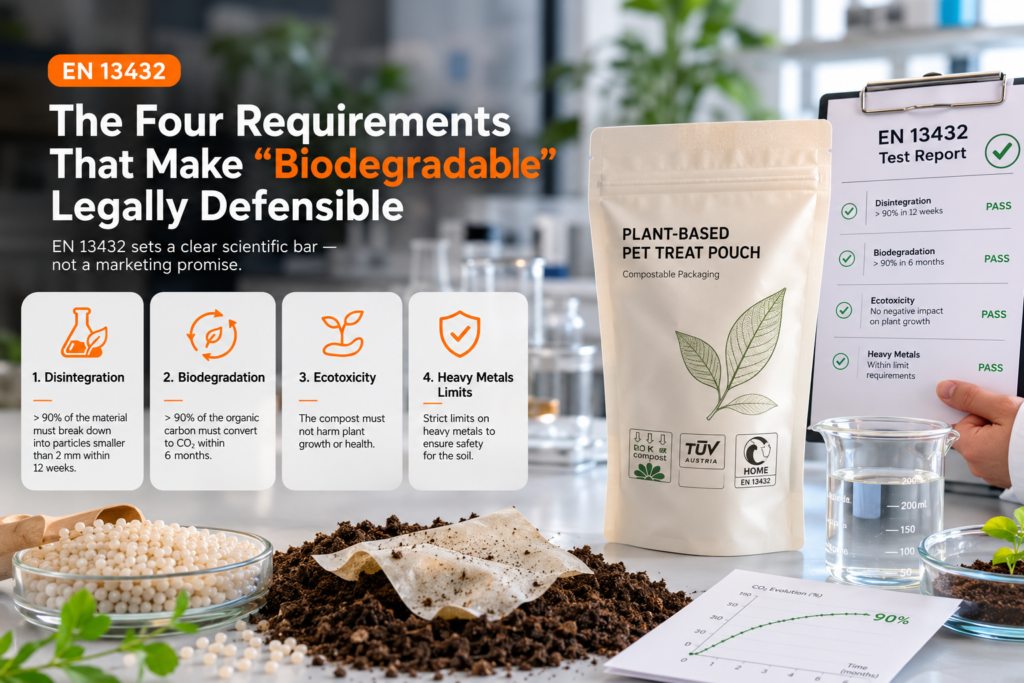
EN 13432 is the harmonised European standard for compostable packaging. Many suppliers treat it as a certificate to frame. In practice, it is a four-part technical barrier — and failing any one part voids the claim.
Biodegradation: The material must reach at least 90% biodegradation within 6 months under controlled industrial composting conditions, measured against a reference material — not against ambient air. This is a chemical decomposition metric, not a visual inspection.
Disintegration: After 12 weeks of composting, no more than 10% of the material may remain as fragments larger than 2 mm. If visible pieces persist, the material has not disintegrated sufficiently — regardless of what the biodegradation curve shows.
Ecotoxicity: The resulting compost must pass plant-growth testing, typically OECD 208 seedling emergence and growth. Compost that stunts plant development fails, even if the material technically biodegraded. This is the gate that catches under-formulated blends.
Chemical composition: Heavy metal concentrations must stay below specific absolute thresholds — for example, cadmium ≤ 0.5 mg/kg dry matter, lead ≤ 50 mg/kg dry matter. These are not borrowed from food-contact legislation. They are defined within EN 13432 itself, and the limits are substantially tighter than general industrial thresholds.
Three distinctions matter at the procurement stage: “biodegradable” is not synonymous with “compostable.” “Industrially compostable” is not interchangeable with “home compostable.” Neither implies marine biodegradability. Conflating these terms in labelling or supplier documentation is the fastest route to a regulatory challenge under EU consumer protection law.
Oxo-degradable plastics deserve separate treatment. Under Article 5 of the EU Single-Use Plastics Directive (2019/904), oxo-degradable plastic products are prohibited from being placed on the EU market. Fragmenting into microplastic is not degradation. The ban is absolute and enforced.
OK Compost HOME vs OK Compost INDUSTRIAL: The Certification Gap
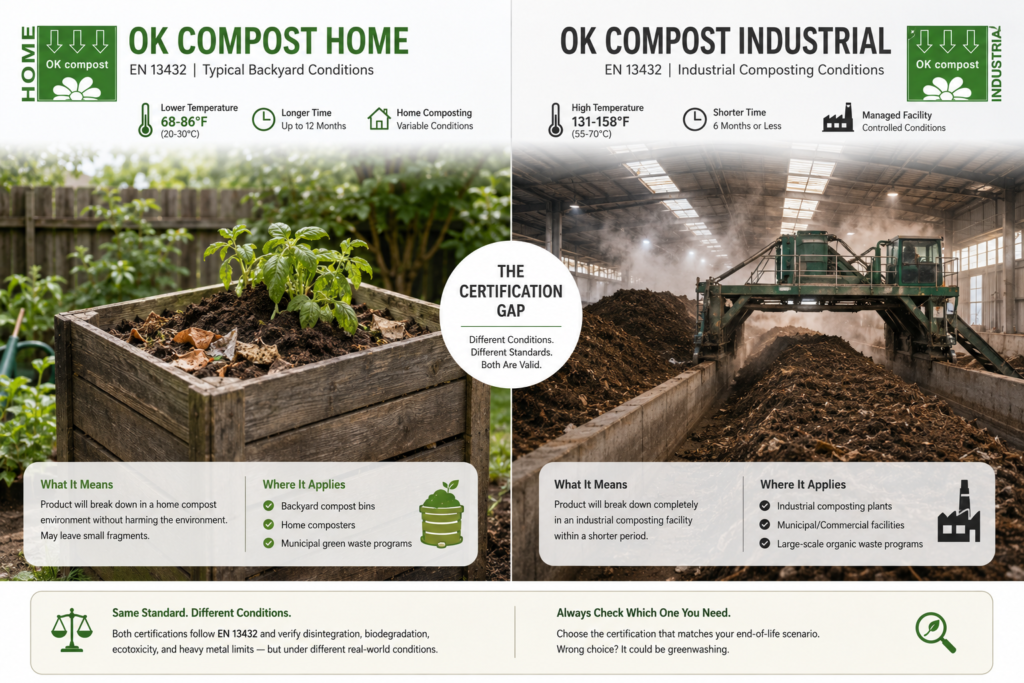
TÜV Austria’s compostability certification operates on two tiers, and the distinction catches B2B buyers regularly.
OK Compost INDUSTRIAL assumes a managed facility: elevated temperature (typically 50–60°C), controlled moisture, and mechanical turning. This is the baseline. Most EN 13432-aligned materials qualify here.
OK Compost HOME requires degradation at ambient backyard conditions — roughly 20–30°C, without industrial process intervention. Fewer materials pass. Fewer structures pass. Multi-layer films, in particular, struggle because adhesive layers and barrier coatings that perform at industrial temperatures may not break down in a home pile.
For B2B positioning: “industrially compostable” is the compliance floor. “Home compostable” is a premium claim that commands higher margins — but demands stricter material selection and more rigorous documentation. If a supplier cannot articulate which certification tier applies to which SKU, they likely do not have either. Mesete currently holds EN 13432 industrial compostability certification; OK Compost HOME certification with TÜV Austria is in progress.
The Material Landscape: PLA, PBAT, PHA, and TPS Compared
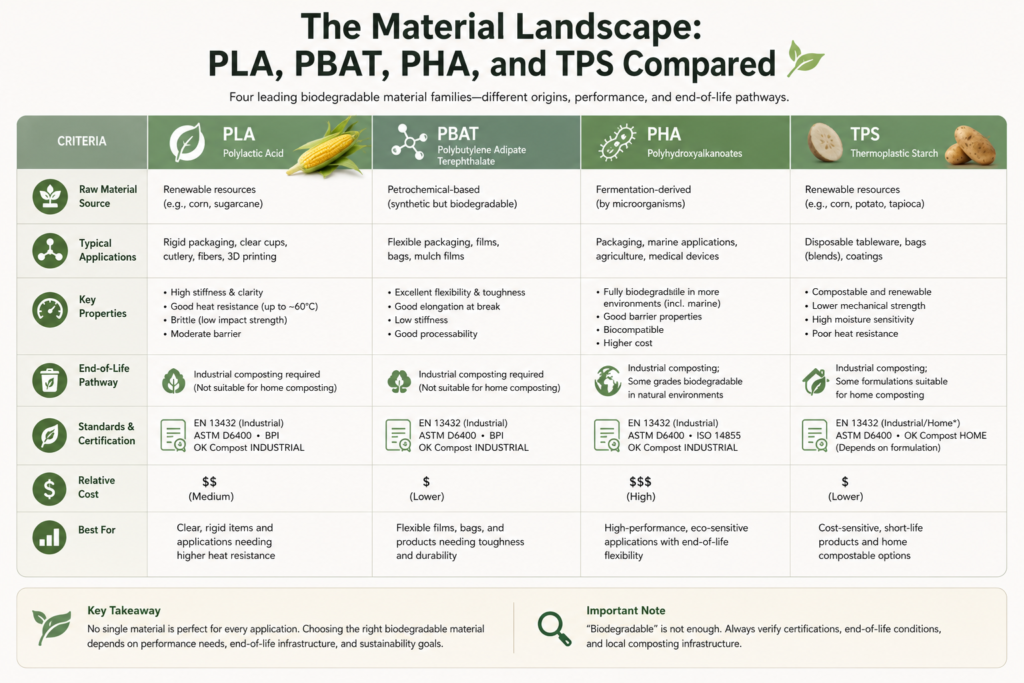
Sustainable pet packaging is not a philosophical choice. It is a mechanical one. A dog treat pouch must seal. A poop bag must stretch without tearing. A scooped tray must survive transport heat and shelf stacking. Material selection determines whether the product functions — and whether the sustainability claim survives real-world use.
| Material | Feedstock | Degradation | Mechanical Profile | Cost Index* | Pet Application |
|---|---|---|---|---|---|
| PLA | Plant sugars (corn, sugarcane) | Industrial composting | Clear, stiff, good printability; low heat resistance | 1.3–1.6 | Treat windows, rigid inserts, some trays |
| PBAT | Fossil-based, compostable | Industrial composting, often in blends | Flexible, tough, high tear resistance | 1.4–1.8 | Poop bags, flexible films, pouches |
| PHA | Bio-based, microbially produced | Broader degradation profile | Good barrier potential; processing can be challenging | 2.0–3.0 | Premium films, niche molded parts |
| TPS | Thermoplastic starch | Usually blended; managed conditions needed | Lower durability alone; moisture-sensitive | 1.1–1.4 | Liners, blend component, selected bags |
*Cost index relative to common conventional packaging resins. Not a market quote.
Two technical points carry disproportionate weight in procurement decisions:
PLA’s thermal limitation. PLA enters its glass transition at approximately 55–60°C. A PLA-heavy component left in a hot container during summer transit, or positioned near a heated component in a smart pet device, can deform. For water fountain housings, heated bowl accessories, or any application involving repeated hot-water contact, PLA may be structurally unsuitable regardless of its sustainability profile.
PBAT/PLA blend ratios are not interchangeable. Increasing PBAT content improves flexibility and tear resistance but can slow degradation kinetics. Increasing PLA content raises stiffness and gloss, often at the expense of brittleness. If you are commissioning a custom compostable film for treat pouches or waste bags, require the supplier to document the actual blend ratio — not “a biodegradable formula.” The ratio. On paper. Against the certified grade.
Auditing a Supplier’s Sustainability Claims: A 5-Step Framework
You do not need to become a polymer scientist. You do need to stop accepting certificate photos as evidence.
- Verify the certificate with the certifier. Check the certificate number against the TÜV Austria certified products database or DIN CERTCO’s certification registry. A PDF attachment in an email proves nothing on its own.
- Match the polymer grade to the purchase order. A certified resin family is not the same as the exact grade running through your product. Confirm the grade code on the certificate matches the grade code on the production BOM.
- Request third-party batch degradation reports. Factory-issued statements are marketing. Independent lab reports — showing batch-level biodegradation and disintegration data — are verification.
- Trace the finished batch backward. Your finished goods batch number should map to the raw material lot number, which should map to the resin supplier’s certificate of analysis. If any link in that chain is missing, the traceability claim is incomplete.
- Inspect the factory floor. Regrind practices, energy metering granularity, waste segregation discipline, and wastewater pretreatment are where sustainability claims either hold or collapse. See Mesete’s full sustainability commitments — and compare them to what you observe on the production line.
What Sustainable Manufacturing Looks Like on a Factory Floor
A factory does not become sustainable by updating its brochure photography. Four operational signals separate genuine practice from marketing:
- Regrind loop: Injection gate and runner scrap is reprocessed with a defined cap — typically 10–15% for validated non-critical parts, and lower or zero where compostability certification or appearance specifications prohibit reclaimed content.
- Energy metering: Line-level meters on major molding and extrusion lines, not a single whole-factory meter that conceals per-process consumption. If a supplier cannot report energy intensity per product category, the data is not managed.
- Waste segregation: Hazardous waste, general solid waste, and recyclable streams occupy three separate, labeled zones with auditable pickup records. Mixed bins are a warning sign.
- Packaging reduction: FSC-certified cartons, elimination of plastic film lamination on outer packaging, and soy-based inks where print performance specifications allow.
On the service side, a competent European-facing OEM should offer material down-gauging analysis for flexible packaging, barrier optimization for compostable pet food formats, transit testing under ISTA or equivalent protocols, and retailer-ready compliance documentation packs. Some suppliers are also supporting mono-material migration for brands preparing for recyclability targets under the PPWR — which brings us to the regulatory horizon.
What’s Coming: PPWR and the End of Vague Eco Claims
Two legislative developments reshape sustainable pet product sourcing in 2026:
Packaging and Packaging Waste Regulation (EU) 2025/40 — applies generally from August 12, 2026. Near-term obligations include packaging minimisation requirements and material labelling. Mandatory recycled-content thresholds are largely a 2030 milestone, not an immediate one. When budgeting tooling, artwork revisions, or claims strategy, keep those timelines separate.
Empowering Consumers for the Green Transition Directive (EU) 2024/825 — in force, applying from September 27, 2026. This is the binding legislation that targets generic, unsubstantiated environmental claims. Terms like “eco-friendly,” “green,” or “biodegradable” — used without specifying the standard, scope, and disposal context — become enforceable liabilities. The so-called Green Claims Directive, frequently cited as if settled, has not been adopted. EmpCo is the law that lands first.
For B2B buyers, the operational implication is straightforward: evaluate suppliers not by who uses the most sustainability adjectives, but by who documents the claim boundary. Under which standard? For which SKU? Using which resin grade? Under which disposal pathway? That level of specificity is no longer best practice. It is becoming the regulatory baseline.
Frequently Asked Questions
Is “biodegradable” alone a safe label to use in the EU?
No. Without a specified standard, disposal context, and evidence trail, the term is too vague to satisfy EU consumer protection requirements. Pair it with EN 13432 or an equivalent harmonised standard.
Do I need EN 13432 certification for the finished product or just the raw material?
Finished-product certification carries more weight. Raw material certification is a starting point, but additives, inks, adhesives, lamination, and structural design can change the outcome. Test the article as sold.
Can a supplier’s compostability claim be verified independently?
Yes. Check certificate numbers against the certifier’s public database, request third-party batch test reports, and trace finished goods batches through raw material lots to resin supplier certificates of analysis.
How does the EU Single-Use Plastics Directive affect oxo-degradable claims?
Oxo-degradable plastics are prohibited from the EU market under Article 5 of Directive 2019/904. Fragmentation into microplastic is not accepted as a valid environmental outcome.
Are plant-based materials always the more sustainable choice?
Not automatically. Feedstock origin, blend composition, processing energy, transport distance, end-of-life disposal pathway, and product failure rates all contribute to the full environmental picture. A poorly engineered plant-based structure can underperform a well-designed conventional alternative on net impact.
Build a more sustainable product line
Mesete supports B2B brands with EN 13432 certified compostable materials, plant-based polymer development, and full material traceability — from resin supplier to finished shipment. Every order includes a compliance documentation package: certificate of conformity, relevant test reports, material declarations, and SDS sheets. Review our full sustainability commitments, then tell us your product category and target market. Our engineering team will recommend the right material strategy for your next OEM or ODM project.
Last updated: July 2026. Reviewed by the Mesete Product Engineering Team. External references: EU SUP Directive 2019/904, PPWR (EU) 2025/40, EmpCo Directive (EU) 2024/825, TÜV Austria certified products, DIN CERTCO.
Free download
Smart Pet Feeder — Supplier Evaluation Checklist
A 1-page checklist to vet smart feeder suppliers: FCC/CE, app stability, MOQ, tooling ownership and lead time.
No spam. Unsubscribe anytime.
Ready to source smart pet products?
Tell us your target market and volume — we'll match the right factory, handle compliance, and quote within 24 hours.