EU Pet Product Import Regulations 2026: CE, RoHS, REACH Explained
 ·
·
9 min read
·
109 reads
·
·
9 min read
·
109 reads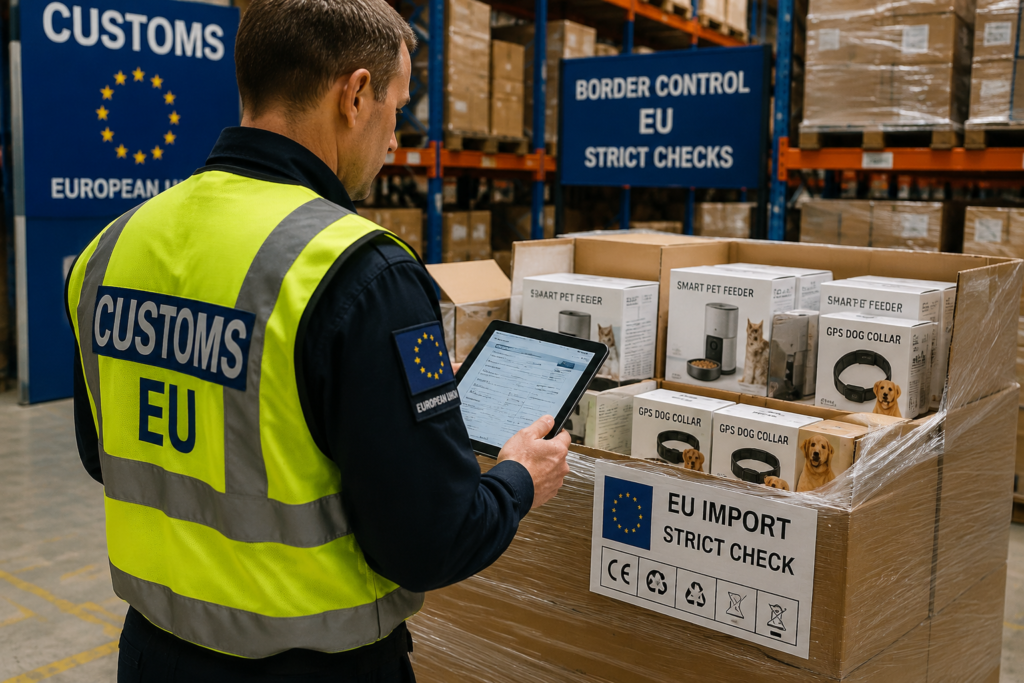
On this page
Every year, pallets of smart feeders, automatic litter boxes, and pet cameras hit the EU border and get stopped — not because the product is bad, but because the compliance paperwork is wrong or incomplete. For importers bringing pet electronics into Europe in 2026, three frameworks do the heavy lifting: CE marking, RoHS, and REACH. This article explains what each one demands, what your supplier should provide, and what you — as the importer — are legally on the hook for.
Who this applies to: If your product has a PCB, a motor, a sensor, a battery, a charger, or wireless connectivity — and you’re placing it on the EU market — this article is for you. Non-electronic pet goods (leashes, ceramic bowls, grooming brushes) generally fall outside CE/RoHS scope. Animal-origin pet food is a separate regulatory path under the official controls framework and is not covered here.
CE Marking: The Non-Negotiable Passport
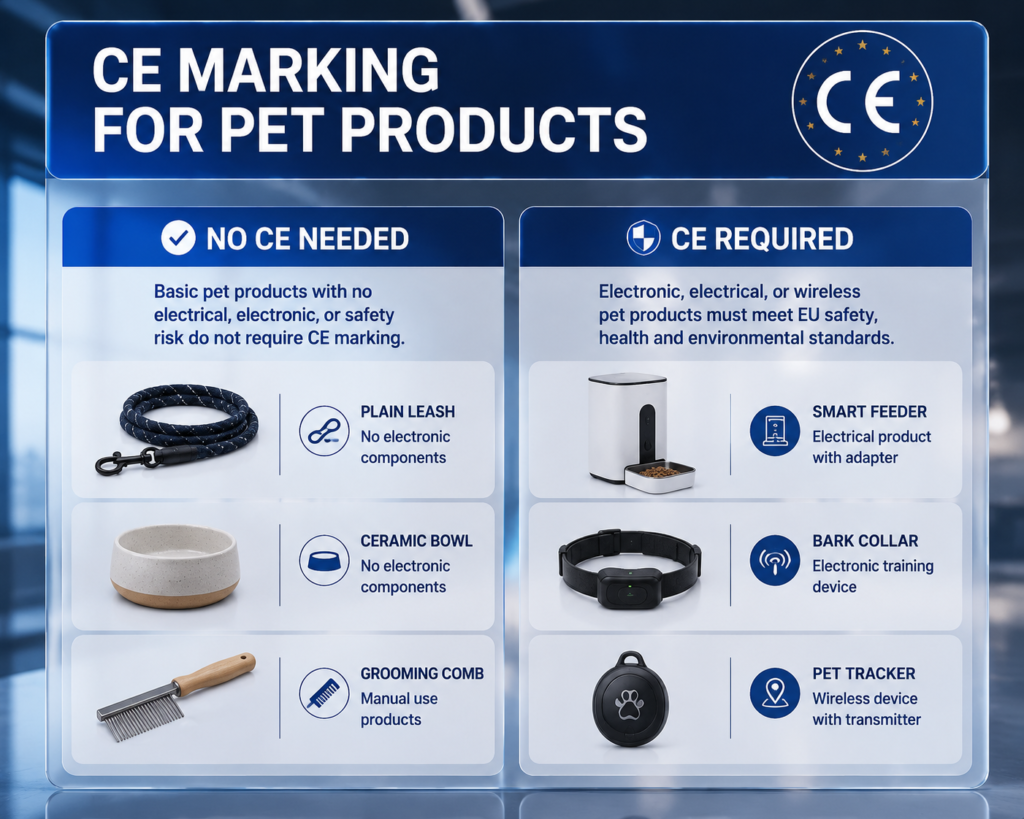
CE marking is not a certificate someone in Brussels mails you. It is a legal declaration that the product complies with every EU directive and regulation that applies to it. For pet electronics — smart feeders, water fountains, automatic litter boxes, bark collars, pet cameras — the applicable legislation typically includes the Radio Equipment Directive (RED) if wireless, the Low Voltage Directive (LVD), the Electromagnetic Compatibility Directive (EMC), and RoHS.
The split most importers need to understand:
- Self-declaration — the manufacturer compiles technical documentation, applies harmonised standards, performs conformity assessment, and signs an EU Declaration of Conformity (DoC). Most pet electronics fall here.
- Notified body involvement — required only for certain product categories or when the manufacturer chooses a conformity route that demands third-party assessment.
In 2026, the rules themselves haven’t changed much. Enforcement has. German, French, Dutch, and Nordic market surveillance authorities are now faster to ask: Where is the DoC? Which directives apply? Who is the EU importer? Why does the label name not match the test report? Online marketplaces are also tightening listing requirements for electronic goods.
A supplier waving a “CE certificate” JPG is not evidence of compliance. Ask for the EU Declaration of Conformity, signed, with a listed product model that matches your SKU.
RoHS: What’s in Your PCB Matters
If your pet product has a printed circuit board, cable, charger, motor driver, LED module, sensor, or battery management board — RoHS is not optional. It restricts ten hazardous substances in electrical and electronic equipment: lead, mercury, cadmium, hexavalent chromium, PBB, PBDE, and four phthalates (DEHP, BBP, DBP, DIBP).
In practice, the three places trouble hides:
- Lead in solder — the most common silent failure. XRF screening catches it in minutes.
- Phthalates in soft plastics — cable jackets, gaskets, suction cups, chewable edges.
- Cable and adapter composition — often sourced from a different supplier than the main assembly, with its own compliance gap.
A competent factory provides: the EU DoC, RoHS test reports tied to the current model and bill of materials (BOM), material declarations for PCB/adapter/cable/plastics, and any exemption claims properly documented. If the company name on the report doesn’t match the legal supplier name, or the model number is “close enough,” treat the file as non-compliant until proven otherwise.
REACH: Beyond the Product — The Full Substance Story

RoHS focuses on a fixed list of restricted substances in electronics. REACH is broader. It follows the substance story through the entire article — coatings, silicone parts, foam inserts, adhesives, synthetic leather, colorants, the chewable edge of a dog toy.
The ECHA Candidate List of Substances of Very High Concern (SVHC) is updated roughly every six months and exceeded 250 entries by mid-2026. If an SVHC is present above 0.1% weight by weight in an article, Article 33 communication duties kick in: business customers must receive enough information for safe use, and consumers can request it too. Article 7(2) may also require notification to ECHA under certain volume conditions.
| Topic | RoHS | REACH |
|---|---|---|
| Scope | Electrical and electronic equipment | Substances, mixtures, and articles |
| Substance list | Fixed: 10 restricted substances | Living candidate list, updated ~biannually |
| Pet product risk areas | PCB solder, cables, soft plastics | Coatings, foams, straps, adhesives, textiles |
| Core document ask | RoHS test report + DoC | SVHC statement, material declaration, Article 33 data |
| Why importers fail | Old test reports from unrelated models | Zero substance visibility beyond Tier 1 supplier |
For pet products, material choices matter more than importers assume. Saliva, scratching, abrasion, and close skin contact all raise exposure risk. A silicone feeder seal, a collar lining, a soft-touch coated water fountain — these deserve the same scrutiny as the electronics inside them.
What Else: WEEE, GPSR, Battery Regulation
Three more frameworks importers should know, in brief:
- EU Battery Regulation 2023/1542 — If your smart pet device contains a portable battery, the 18 August 2026 labeling deadline applies. Get a sample label matching Annex VI Part A requirements, not an email promising one.
- WEEE — Germany is especially strict on producer registration. Electrical pet products placed on the German market require registration before sale.
- General Product Safety Regulation (GPSR) — replaced the older GPSD. If a non-harmonised product can injure, choke, overheat, or fail predictably, the importer owns the safety case. A “for pet use only” label does not fix a dangerous product.
EN 13432 and compostable packaging claims deserve their own conversation — see our article on sustainable pet product manufacturing once it’s live. For now: don’t print green claims on packaging without substantiation.
How to Verify Your Manufacturer’s Compliance
Knowing the regulations is step one. Verifying your supplier actually complies is where most import programs succeed or fail. Plenty of factories know the vocabulary. Fewer can back it up with current, model-specific documentation.
Four steps to verify before committing to production:
- Ask for the DoC and test reports — not certificate photos, not “we have CE.” Request the signed EU Declaration of Conformity and the lab test reports behind it.
- Match the entity names — the company name on the lab report, DoC, packaging, and commercial invoice should all align. Discrepancies are a red flag.
- Check the notified body — if the supplier claims third-party assessment, verify it in the EU NANDO database.
- Audit with a compliance lens — during a factory audit, review label artwork, BOM version control, and — for battery devices — an actual Annex VI Part A label sample.
A reliable manufacturer treats compliance documentation as routine, not a favor. At Mesete, every shipment includes a compliance documentation package: DoC, relevant test reports, SVHC statement, and labeling files — organized per SKU, not per “trust me.”
EU Importer Obligations: What YOU Are Responsible For
This is the part many first-time importers misunderstand. The importer placing the product on the EU market is the responsible economic operator — not the factory. Your obligations include:
- Traceability — your name and contact details on the product or packaging where required.
- Language — instructions and safety information in the official language(s) of the destination member state.
- Record retention — technical documentation and the DoC kept available for 10 years where the legislation specifies.
- Production consistency — the hundredth unit should match the tested sample, not just the first one.
- Incident reporting — under GPSR, serious product safety incidents may need reporting within approximately 48 hours. Not “after the holiday.” Not “once the supplier replies.”
Competitors underplay this section because it’s less glamorous than talking about test labs. That’s exactly why writing about it clearly builds trust with serious B2B buyers.
Compliance Checklist for First-Time Importers
Use this as a yes-or-no filter before wiring the balance payment:
| # | Checkpoint | Yes / No |
|---|---|---|
| 1 | Product category confirmed: electronic, non-electronic, or battery-powered | |
| 2 | Applicable EU directives/regulations mapped for the exact SKU | |
| 3 | EU Declaration of Conformity received — signed, model-specific | |
| 4 | Test reports match current model, BOM, and supplier legal name | |
| 5 | RoHS substance data covers PCB, cables, plastics, and adapter | |
| 6 | REACH SVHC statement current against latest ECHA candidate list | |
| 7 | Battery-powered device label checked against Annex VI Part A (deadline: 18 Aug 2026) | |
| 8 | WEEE and national registration obligations confirmed for target countries | |
| 9 | Product label, importer details, and user instructions in destination language(s) | |
| 10 | Shipment documentation archived for traceability and 10-year retention |
If you can’t tick at least eight before production finishes, you’re not managing compliance — you’re betting the border won’t notice. Borders in 2026 notice.
Frequently Asked Questions
Do I need both CE and RoHS for pet electronics?
Yes. RoHS sits within the CE compliance package for most electrical products. A smart feeder or bark collar typically needs CE marking — and RoHS is part of what makes that CE marking valid.
Do samples need certification before a bulk order?
They need enough pre-checking before you commit money. A physical sample without a compliance file tells you shape and finish, not legal readiness. Review draft labels, draft DoC, BOM, and preliminary test data before approving mass production.
Does REACH only apply to chemicals?
No — this is the most expensive misunderstanding in pet product importing. REACH also applies to articles (collars, bowls, housings, straps, foam pads, toy materials). Any SVHC above 0.1% w/w triggers communication obligations.
Do EU requirements differ between member states?
The core regulations are harmonised, but enforcement rigor, language requirements, and national registrations (especially WEEE) vary. Germany is notably strict on producer registration. Research your target country specifically.
What happens if a test report is outdated?
Most genuine lab reports don’t “expire” — they become stale because the model changed, the regulation changed, or the BOM drifted. Treat an outdated or irrelevant document as non-compliant until replaced with current data.
Ask for the compliance file first. The discount can wait.
If you’re sourcing pet electronics for the EU market, make compliance documentation your first request — before price negotiation, before MOQ discussion, before timeline promises. A factory that can’t produce a clean compliance file in 48 hours will cost you more at the border than you’ll save on unit price.
Mesete ships smart pet hardware — automatic litter boxes, feeders, water fountains, and air purifiers — to 50+ countries with CE, RoHS, REACH, and FCC documentation included as standard. Not sure which regulations apply to your product category? Tell us your target market and SKU type — our compliance team will map the applicable framework and quote within 24 hours.
Last updated: July 2026. Reviewed by the Mesete Product Compliance Team. External references: EUR-Lex, ECHA Candidate List, EU NANDO database.
Free download
Smart Pet Feeder — Supplier Evaluation Checklist
A 1-page checklist to vet smart feeder suppliers: FCC/CE, app stability, MOQ, tooling ownership and lead time.
No spam. Unsubscribe anytime.
Ready to source smart pet products?
Tell us your target market and volume — we'll match the right factory, handle compliance, and quote within 24 hours.